
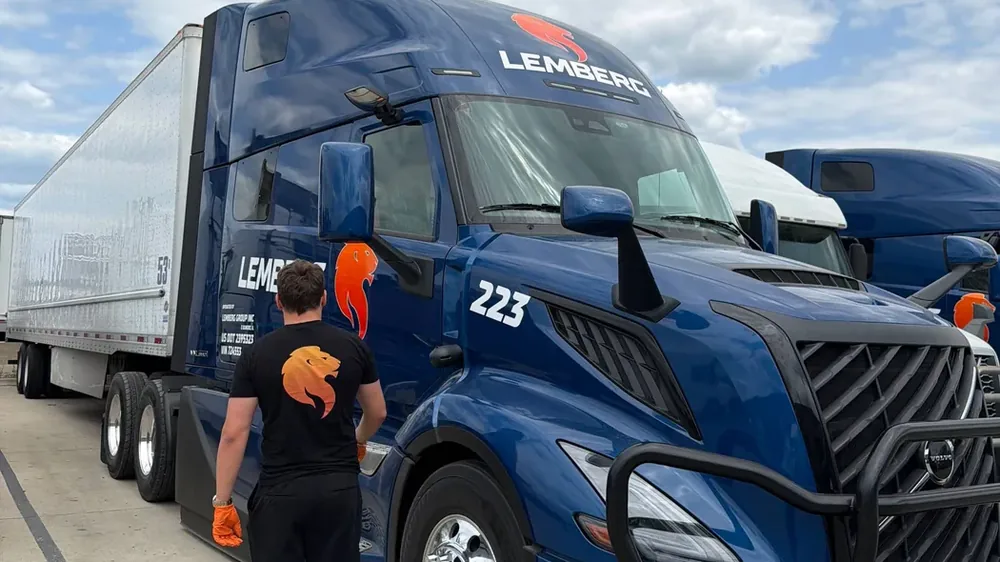
The outside is 53 feet. The inside is not.
A standard 53-foot dry van gives you roughly 52 feet 6 inches of usable floor, 99 inches of width between the walls, and about 110 inches of height down the centre — less at the sides, where the roof bows in.
The number that catches people out is the rear door opening: around 93 inches high and 98 wide. Freight that clears the ceiling inside the trailer still has to pass through an opening more than a foot shorter than that ceiling. Tall, rigid items are where this shows up.
Pallets: twenty-six, not thirty
With standard 48×40 pallets loaded straight — the 40-inch side across, two side by side — a 53-foot van holds 26. Thirteen rows of two, and the last few inches of floor go unused.
You can reach 28 or 30 by pinwheeling: turning alternate pallets so that a 48-inch side and a 40-inch side sit next to each other across the 99-inch width. It works. It also needs a dock crew willing to do it, and it makes the trailer harder to unload in order at the far end.
If a bill of lading says 30 pallets and nobody has mentioned pinwheeling, that freight is not going on one truck. Better to find that out at the quoting stage than at the dock.
Weight: 80,000 is the ceiling, not your allowance
The federal gross limit on the interstate system is 80,000 pounds, and that figure covers everything — tractor, trailer, fuel, driver and freight. A late-model sleeper tractor and a 53-foot van together weigh somewhere between 32,000 and 35,000 pounds empty, which leaves roughly 42,000 to 45,000 pounds for the load.
That spread is not trivia. A heavier-spec truck — larger sleeper, bigger fuel tanks, auxiliary power unit — can take two or three thousand pounds out of the payload. On a load sitting near 45,000, that is the difference between rolling and being turned around at a scale.
The limit people forget is the axle, not the gross
Gross weight is only half the rule. Each axle group carries its own maximum: 12,000 pounds on the steer axle, 34,000 on the drive tandem, 34,000 on the trailer tandem.
A trailer can sit comfortably under 45,000 pounds of freight and still be illegal, because the weight was loaded too far forward or too far back. That is what drivers are doing when they slide tandems — moving the axle position to shift weight between the groups.
Dense freight is the usual cause: canned goods, liquids, paper, anything heavy for its size. A load that is all in the nose of the trailer can fail a scale while the total weight is perfectly legal. If your product is heavy for its volume, say so before the truck arrives.
Four lines that decide whether the right truck shows up
- Pallet count and dimensions, and whether the freight is stackable.
- Actual total weight. Not «about a full load».
- Floor-loaded or palletized, and whether it will be loaded by your crew.
- Dock or ground level. No dock means a forklift has to come from somewhere — a dry van tractor does not carry one.
None of this is complicated, and all of it is cheaper to establish in an email than in a driveway.